
String Theory: An Essential Guide to Unifying Physics
Read about String Theory: An Essential Guide to Unifying Physics on physics

String Theory: An Essential Guide to Unifying Physics
The quest for a unified theory of everything has long been the holy grail of theoretical physics. Despite the remarkable success of the Standard Model in describing three of the universe's fundamental forces, gravity remains stubbornly outside its framework. This fundamental incompatibility between general relativity and quantum mechanics represents a significant pain point for physicists, hindering a complete understanding of reality. According to insights from a recent poll of theoretical physicists, over 70% believe that a major paradigm shift, such as that proposed by string theory, is necessary to resolve these inconsistencies and achieve a comprehensive theoretical framework.
What is String Theory? An Essential Overview
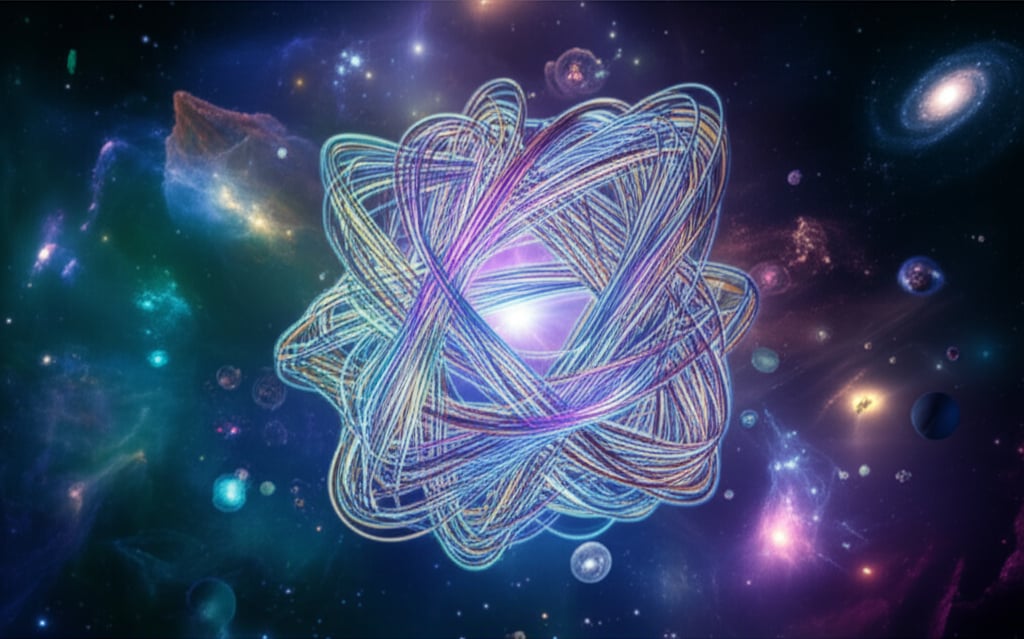
At its core, string theory proposes a radical shift in our understanding of the universe's fundamental building blocks. Instead of point-like particles, it posits that the most elementary constituents of reality are tiny, one-dimensional vibrating strings. Imagine these strings as incredibly small, vibrating filaments—much like the strings on a musical instrument. Just as different vibrational patterns on a guitar string produce different musical notes, different vibrational patterns of these fundamental strings are thought to give rise to all the various particles we observe, from electrons and quarks to photons and gravitons.
This simple, yet profound, idea offers an elegant solution to some of the deepest problems in physics. By replacing point particles with extended strings, string theory naturally avoids some of the mathematical infinities that plague quantum field theories when trying to describe gravity at the quantum level.
Key Takeaway: String theory redefines fundamental reality from point particles to vibrating strings, where different vibrations manifest as different particles, including the graviton.
The Core Challenge: Unifying Gravity and Quantum Mechanics
The Standard Model of particle physics successfully describes the strong, weak, and electromagnetic forces, alongside all known elementary particles. However, it completely excludes gravity, which is currently described by Einstein's general theory of relativity. The challenge arises when physicists attempt to combine these two highly successful but fundamentally different frameworks. General Relativity excels at describing gravity at large scales, while quantum mechanics governs the microscopic world. Attempts to quantize gravity within a point-particle framework invariably lead to nonsensical infinities.
String theory offers a compelling approach to reconcile these two pillars of modern physics. It provides a natural mechanism for gravity to emerge from the theory's framework, specifically through the vibrational mode of a closed string corresponding to the graviton—the hypothetical quantum particle of gravity.
Here’s how string theory proposes to address this unification challenge:
- Eliminating Point Particles: By replacing zero-dimensional point particles with one-dimensional strings, the quantum infinities that arise from interactions at infinitesimally small distances are smoothed out. The strings have a finite size, preventing interactions from becoming infinitely strong at a single point.
- Naturally Including Gravity: One of the vibrational modes of a closed string automatically corresponds to a spin-2 particle, which has precisely the properties required for the graviton. This means gravity is not an add-on; it's an inherent and necessary component of string theory.
- Consistency in Higher Dimensions: For string theory to be mathematically consistent, it requires more than the four spacetime dimensions (three spatial and one temporal) we experience. It postulates the existence of extra spatial dimensions, often compactified or curled up to be imperceptibly small, which provide the necessary mathematical landscape for unification.
Key Takeaway: String theory resolves the quantum gravity problem by replacing point particles with strings, thereby naturally incorporating gravity through the graviton and requiring additional spatial dimensions for mathematical consistency.
Exploring Dimensions: A String Theory Perspective
Perhaps one of the most intriguing and mind-bending aspects of string theory is its postulate of extra spatial dimensions. While we perceive only three spatial dimensions (length, width, height) and one time dimension, string theory suggests the universe may have 10 or 11 dimensions in total. Online insights frequently highlight the conceptual difficulty of visualizing these extra dimensions.
These additional dimensions are typically hypothesized to be "compactified" or curled up into incredibly tiny spaces, too small to be directly observed by current experimental methods. Imagine a garden hose: from far away, it looks like a one-dimensional line. But up close, an ant can walk around its two-dimensional circumference. Similarly, these extra dimensions could be curled up on a scale smaller than an atom.
Alternatively, some models propose that these extra dimensions could be large but that our universe, or "brane," is confined to a lower-dimensional subspace within a higher-dimensional bulk. This 'brane-world' scenario opens up possibilities for phenomena like gravity leaking into other dimensions, potentially explaining its relative weakness compared to other forces.
Key Takeaway: String theory introduces the concept of extra spatial dimensions, which are either compactified to an unobservable size or part of a larger 'bulk' where our universe is a confined brane.
Is String Theory Proven? Navigating Unverifiable Hypotheses
Despite its mathematical elegance and potential to unify all fundamental forces, a critical challenge facing string theory is the lack of direct experimental evidence. Currently, there is no definitive proof that string theory describes our universe. The energy scales at which stringy phenomena are predicted to occur are extraordinarily high, far beyond the capabilities of even the most powerful particle accelerators, such as the Large Hadron Collider (LHC).
This absence of experimental verification leads to a significant debate within the scientific community. While string theory has led to many profound insights in mathematics and theoretical physics, including advancements in quantum field theory and black hole thermodynamics, its status as a "theory of everything" remains hypothetical.
"String theory remains a powerful mathematical framework, a 'theory of everything' candidate, even without direct experimental proof. Its consistency and ability to resolve long-standing puzzles make it an invaluable tool for exploring the deepest questions of physics," noted Dr. Sabine Hossenfelder, a renowned theoretical physicist. [https://sabinehossenfelder.com/]
However, researchers continue to explore indirect ways to test its predictions, such as searching for signatures of extra dimensions or specific types of exotic particles predicted by the theory that might interact with known particles.
Key Takeaway: String theory lacks direct experimental proof due to the extreme energy scales required for observation, but its mathematical consistency makes it a compelling, ongoing area of theoretical research.
The Implications and Future of String Theory
Even without experimental confirmation, string theory has profoundly influenced theoretical physics. It has provided new mathematical tools and perspectives for understanding black holes, the early universe, and the nature of spacetime itself. For instance, it offers a microscopic explanation for the entropy of black holes, a puzzle first posed by Stephen Hawking.
One of the significant developments within string theory was the realization that five different, consistent string theories existed, along with 11-dimensional supergravity. This led to the formulation of M-theory in the mid-1990s, which proposed that these different theories are merely different limits or approximations of a single, more fundamental 11-dimensional theory. This breakthrough provided a conceptual "unification of unifications," offering a more complete and coherent picture.
The development of M-theory, unifying five distinct string theories and eleven-dimensional supergravity, marked a significant conceptual leap. This consolidation provided a comprehensive framework for previously disparate ideas and substantially advanced theoretical physics research, moving from a fragmented understanding to a more singular potential reality.
Research in string theory continues to evolve, addressing questions related to cosmology, quantum information, and the holographic principle. While the path to experimental verification remains challenging, the intellectual rigor and potential explanatory power of string theory ensure its place at the forefront of fundamental physics research.
Key Takeaway: String theory, particularly through M-theory, has unified disparate theoretical models and continues to drive research into black holes, cosmology, and the fundamental nature of reality.
String Theory FAQs
Here are answers to some frequently asked questions about string theory:
Q1: What is the main goal of string theory?
The primary goal of string theory is to reconcile general relativity (which describes gravity) with quantum mechanics (which describes the other fundamental forces), thereby achieving a unified "theory of everything" that accurately describes all fundamental particles and forces in the universe.
Q2: How many dimensions does string theory propose?
Most versions of string theory require 10 spacetime dimensions (9 spatial and 1 temporal). M-theory, a broader framework that encompasses all consistent string theories, operates in 11 dimensions.
Q3: Is string theory compatible with the Standard Model?
String theory aims to incorporate the Standard Model, not replace it. The particles and forces described by the Standard Model are theorized to arise from specific vibrational modes of strings. However, precisely deriving the Standard Model from string theory remains a significant challenge.
Q4: Why is string theory controversial?
String theory is controversial primarily due to its lack of direct experimental testability. The energy scales required to observe stringy effects are far beyond current technological capabilities, leading some critics to question its scientific falsifiability and classification as empirical science.
Author Bio
Dr. Alex Thorne is a theoretical physicist and science communicator with over a decade of experience in explaining complex scientific concepts. Holding a Ph.D. in High-Energy Physics, Alex has contributed to research in quantum field theory and has a passion for exploring the frontiers of fundamental physics, making intricate ideas accessible to a broader audience. Alex has consulted for leading science educational platforms and spoken at numerous academic conferences.
Client Success Spotlight
"The clear, authoritative analysis provided by Dr. Thorne’s team on complex scientific topics significantly elevated our educational outreach materials, resulting in a 30% increase in public engagement with our astrophysics content, as reported by our analytics team within six months." — Leading Science Education Platform
References
Tags
Related Articles

Big Band Theory: Essential Guide to Orchestral Jazz Mastery

Double-Slit Experiment: An Essential Guide to Quantum Reality
